Running Your Fleet Like a Business, Not a Logbook
11 August 2026
When Growth Creates Operational Complexity
Most South African transport operators didn’t start out needing an ops department. A bakkie became five trucks, five became twenty, and somewhere along the way the admin caught up faster than the fleet did. Now there’s a WhatsApp group for load instructions, another thread for fuel requests and authorisations, drivers checking in wherever there’s signal, and POD photos of debatable quality landing in a chat that someone still has to save, match to the right load, and file against an invoice built to that client’s specific requirements.
That’s the real ceiling on growth for most transporters, not finding where trucks are- that’s what telemetry tells you- but the admin load that comes with each truck and each driver on the road.
Why Driver Communication Needs More Than WhatsApp
Most of the conversation about transporter systems focuses on the customer side – the shippers wanting visibility, or brokers wanting confidence in the handoff. The sharper disconnect often sits closer to home: between the transporter and the drivers actually running the business day to day, whether they’re on payroll or dedicated subbies operating like part of the fleet.
A WhatsApp thread wasn’t built to carry vehicle inspection records that need to hold up at audit, prove a driver started their day with the right equipment for the conditions ahead, or account for who’s responsible when something goes wrong on the road. This means that Incident reporting ends up as yet another channel a fleet manager has to watch, separate from everything else.
Compliance Is Part of Running a Modern Fleet
Every driver and vehicle on the road represents a stack of documentation that has to stay current and easy to produce: valid licences, cross-border permits, passports for drivers crossing into the rest of SADC, hazchem certificates for the loads that need them, medical certificates that lapse without warning.
For operators running subcontractors as part of their capacity, there’s an added layer of making sure the subbie’s GIT cover actually stretches to cover the value of the load being delegated their way, and that it’s current. When any one of these lapses quietly, it rarely becomes obvious until it’s expensive – at a roadblock, during an audit, or when a claim is rejected.
Bring Operations and Governance Together with one Operating System
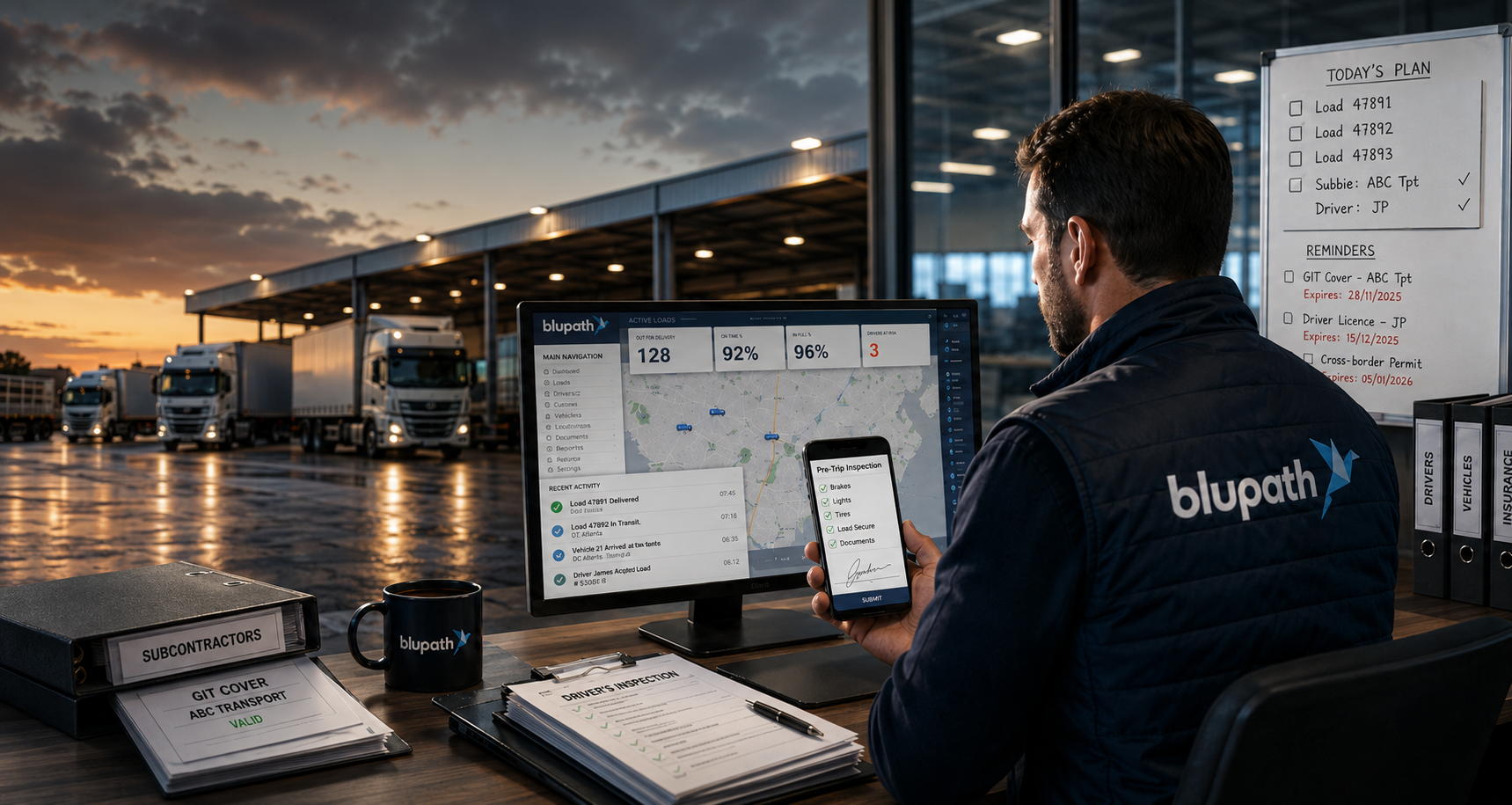
The alternative is treating governance and driver communication as part of the same operating system as the loads themselves, not in side channels of chats, photos, and printouts into Lever Arch files, but one place where instructions go out, PODs come back, inspections get recorded, and licence, permit, and cover expiries are visible before they become somebody’s problem at the worst possible moment.
This is the gap platforms like Blupath are built to close – giving transporters one place to run the relationship with their own workforce, employed or subcontracted, with the same rigour they’d want their customers to see from the outside.
A Simple Test for Your Business
So perhaps ask yourself, check in with your transport business today: pull up your subcontractors’ GIT cover and your drivers’ cross-border documents and see how many you could actually verify are current, right now, without a phone call.
That’s the standard we build to at Blupath – not loud, not flashy, just built with your business and the way you actually run it in mind.